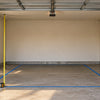
Will a Golf Simulator Fit in My Garage? A Room-Size Guide
Most two-car garages in Southern California can fit a golf simulator. The question is which setup fits yours. Ceiling height is the number that matters most, so start there.
The three measurements
Grab a tape measure and write down three numbers:
- Ceiling height at the spot where you'd stand to swing. Measure to the lowest obstruction, such as a garage door track, opener, or light fixture, not the drywall.
- Width of the open area, wall to wall or wall to parked car.
- Depth from the wall where the screen would hang to the wall behind you.
What each number needs to be
| Measurement | Bare minimum | Comfortable |
|---|---|---|
| Ceiling height | 9 ft | 10 ft or more |
| Width | 10 ft | 12 ft or more |
| Depth | 12 ft | 15 ft or more |
Ceiling height: 9 feet works for most golfers under 6 feet tall swinging a driver, but it's tight. At 10 feet, almost anyone can swing freely. Below 9 feet, you can still practice with irons and wedges, or choose a net-only setup without a full enclosure.
Width: 10 feet fits an enclosure that is comfortable for right-handed or left-handed play, but not both. 12 feet or more lets you center the hitting mat so either side works, which matters if friends or family play.
Depth: Your distance from the screen should be 8 to 10 feet for safety and for the ball to register on most launch monitors. Add 3 to 4 feet behind you for a backswing and room to walk around. Camera-based launch monitors that sit beside the ball need less depth than radar units that sit 6 to 8 feet behind you.
The most common garage obstacle
Garage door tracks and openers hang 12 to 18 inches below the ceiling and usually run through the middle of the space. Two fixes:
- Set up the simulator in the bay the door track doesn't cross, or position the hitting spot between tracks.
- Convert to a high-lift or side-mount opener, which moves the track up along the wall. A garage door company can do this for a few hundred dollars.
If you're short on one measurement
- Low ceiling: use a hitting net instead of a full enclosure, and practice irons. Many golfers run a launch monitor with a net and a tablet instead of a projector and screen.
- Narrow width: choose a compact enclosure, around 8 feet wide, and commit to one-handed setup.
- Shallow depth: choose a camera-based launch monitor that sits next to the ball rather than behind you.
A quick example
A typical SoCal two-car garage is about 20 feet wide, 20 feet deep, with 8 to 10 foot ceilings. With one car parked, you have a 10 by 20 foot bay. If the ceiling is 9 feet or higher, that bay fits a compact enclosure, a hitting mat, and a launch monitor with room to spare. If it's under 9 feet, a net setup is the better call.
Not sure? Send us your numbers
Email your ceiling height, width, and depth to info@simplegolfshop.com and we'll tell you what fits, no charge. Browse our home golf simulators and practice mats and nets to see the options.
-
Posted in
buying guide, garage, golf simulator, home practice, simulators